 EN
EN

Match Cargo Needs to Container Type
Dry, Reefer, and Tank Containers: Core Functions and Ideal Cargo Profiles
Selecting the right container type prevents cargo damage and optimizes shipping costs. Dry containers—weatherproof, steel-built units—are the standard choice for non-perishable, stable goods like electronics, textiles, and furniture. Reefer containers maintain precise temperature control (–30°C to +30°C) with continuous power supply and 24/7 remote monitoring, making them essential for pharmaceuticals, fresh produce, and frozen foods. Tank containers, constructed from food-grade or chemical-resistant stainless steel, safely transport liquid bulk—including edible oils, solvents, and industrial chemicals—in leak-proof, pressure-regulated systems.
- Dry: Most cost-effective option for dry, non-hazardous, dimensionally stable cargo
- Reefer: Required for temperature-sensitive shipments; compliance with ATP (Agreement concerning the International Carriage of Perishable Foodstuffs) is mandatory for EU-bound perishables
- Tank: Designed to UN ISO tank standards (ISO 1496-3), minimizing contamination and spill risk during handling and transit
Specialized Containers for Oversized, Hazardous, or Perishable Shipments
Non-standard cargo demands purpose-built solutions to meet safety, regulatory, and operational requirements. Open-top containers—with removable tarpaulin or rigid roof panels—enable top-loading of tall or heavy machinery. Flat-rack containers (with collapsible ends and no side walls) support oversized, irregular, or project cargo like wind turbine blades or construction equipment. For hazardous materials, IMDG Code-compliant containers feature reinforced corner castings, pressure-relief valves, and UN-certified linings—paired with mandatory hazard placarding and documentation. High-value perishables benefit from advanced reefers with dual-zone temperature control, humidity regulation, and integrated GPS-enabled tracking sensors.
Key considerations include structural load assessments for oversized cargo, UN certification and proper segregation for hazardous goods, and real-time environmental monitoring for sensitive perishables. According to the World Shipping Council, using correctly certified specialized containers reduces damage claims by 18% and helps avoid regulatory fines that average $12,500 per IMDG violation.
Select the Optimal Container Size and Capacity
20ft vs. 40ft vs. 40HC: Comparing Payload, Cubic Capacity, and Cost Efficiency
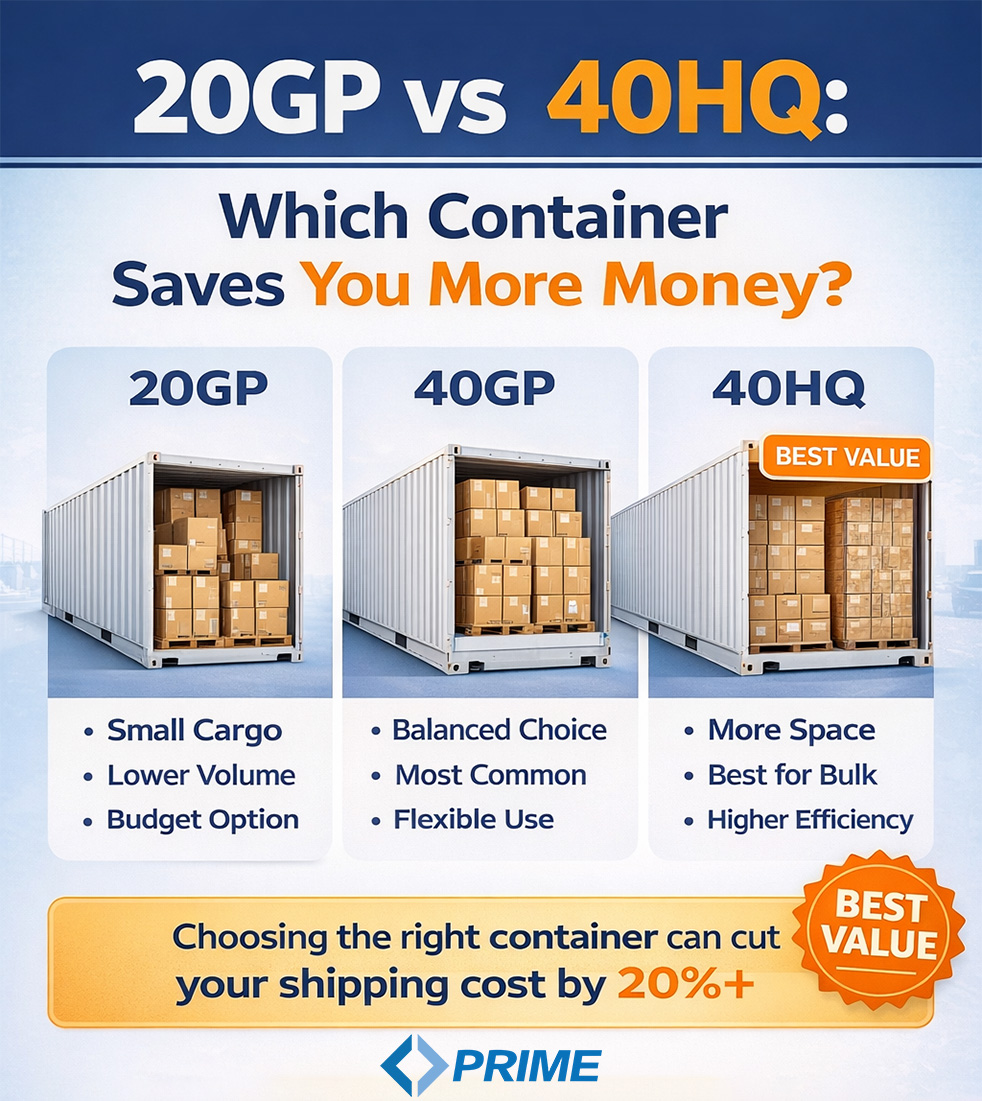
Container size selection directly influences freight economics, cargo security, and port handling efficiency. Standard 20ft dry containers offer ≈33m³ internal volume and a typical payload capacity of 24–28 metric tons—ideal for dense, heavy cargo like steel components or machinery. The 40ft unit doubles cubic capacity (≈67m³) while maintaining similar weight limits, delivering 15–30% lower cost per cubic meter than two 20ft units—especially advantageous for low-density items such as packaging foam or assembled furniture. The 40HC (High Cube), with its 9’6" height and ≈76m³ volume, adds critical vertical space for lightweight voluminous loads like mattresses or palletized apparel—typically commanding only a modest premium over standard 40ft rates.
Avoiding Underutilization or Overloading: Volume-to-Weight Ratio Guidelines
Optimizing container utilization requires balancing volumetric fill against axle and gross mass limits. Use these evidence-based guidelines:
- High-density cargo (e.g., steel coils, ceramics): Prioritize 20ft containers to stay within road/rail axle weight limits while achieving 85–90% volume fill.
- Low-density cargo (e.g., expanded polystyrene, empty bottles): Choose 40HC to reach 90–95% volume utilization without triggering overweight penalties.
Industry analysis from Drewry’s Global Container Trade Review shows improper size selection leads to either 25% wasted space or 12% overweight incidents annually—costing shippers an average of 17% in avoidable inefficiencies. Calculate your cargo’s volume-to-weight ratio early: aim for <2.5 m³/ton for optimal 40ft use, or >3.5 m³/ton when 40HC delivers clear value. Always cross-check against the container’s max gross mass (typically 30,480 kg) and tare weight to ensure structural integrity and stacking safety.
Ensure Container Compliance and Structural Fitness
CSC Plate, ISO Certification, and Cargo-Worthy vs. Wind-and-Water-Tight (WWT) Grades
Every intermodal container used in international trade must bear a valid CSC (Convention for Safe Containers) safety approval plate—verified through load testing, corrosion resistance evaluation, and periodic re-inspection every 30 months. ISO 1496-1 certification ensures dimensional consistency, corner fitting interoperability, and global handling compatibility across ports, rail yards, and vessels. Two functional grades define operational eligibility:
- Cargo-Worthy (CW): Certified by an accredited inspector to carry full payload—including hazardous and heavy cargo—without structural compromise
- Wind-and-Water-Tight (WWT): Meets basic weatherproofing standards but lacks structural validation; suitable only for lightweight, non-hazardous, short-haul shipments
The 2023 Maritime Safety Report notes that 23% of preventable cargo damage claims stem from misusing WWT containers beyond their design limits—often due to inadequate pre-shipment verification.
Pre-Shipment Inspection Checklist: Doors, Seals, Corrosion, and Frame Integrity
Conduct these four critical checks before loading—documented with photos and inspector sign-off—to uphold safety, compliance, and insurance validity:
- Doors & Seals: Confirm smooth operation, intact locking rods, and pliable, undamaged rubber gaskets to prevent moisture ingress and condensation damage
- Corrosion: Inspect floor cross-members, ceiling panels, and door hinges for rust covering >10% surface area—especially critical for reefers, where corrosion compromises insulation and refrigerant integrity
- Structural Frame: Identify dents deeper than 5 cm or bent corner posts, which impair stacking strength and may violate CSC stacking test requirements
- Flooring: Test wooden floors for rot, insect infestation, or delamination; verify steel flooring thickness (minimum 1.2 mm) using ultrasonic gauges to detect hidden corrosion or fatigue cracks
Per the ICC’s 2024 Global Trade Compliance Audit, incomplete or undocumented inspections account for 17% of customs-related delays—and are frequently cited in cargo insurance claim denials.
FAQ
What type of cargo requires reefer containers?
Reefer containers are used for temperature-sensitive shipments like pharmaceuticals, fresh produce, and frozen foods.
What should be considered when selecting a container size?
Consider the type of cargo, its density, and volume-to-weight ratio. 20ft containers are best for high-density cargo, while 40HC containers are ideal for low-density items.
Why is ISO certification important for containers?
ISO certification ensures that a container meets global safety and handling standards, providing interoperability across ports and transport methods.
What are the differences between Cargo-Worthy and Wind-and-Water-Tight containers?
Cargo-Worthy containers are certified to carry full payloads without structural compromise, while Wind-and-Water-Tight containers are only suitable for lightweight, non-hazardous, short-haul shipments.
What are key pre-shipment inspection checks for containers?
Key checks include ensuring doors and seals are intact, inspecting for corrosion, confirming the structural frame is undamaged, and verifying the condition of the flooring.